What is a Control and Information Architecture ?
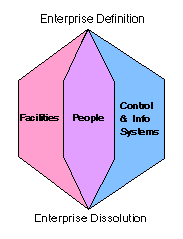 |
The Control and Information
Architecture is one of three basic components of any enterprise (the
other two are the Production Facilites, and the People/Organizational Architectures.) In
the PERA Model, it is usually depicted on the right, although it has an
interface with the "Facilities" of the enterprise, so the diagram might
actually be better represented if it were "wrapped around" into a
sphere.
The term "architecture", as used in this website, refers not only to bricks and mortar structures, but the structure via which material and data move through maufacturing facililites and organizations.
|
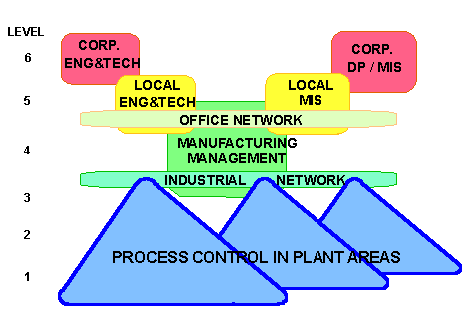
The Control and Information Architecture may be represented by
a series of "Architecture" diagrams, beginning with the Control and
Information Philosophy Diagram, and progressing through increasing
levels of detail, to Network Diagrams (primarily representing physical
network structures), Entity Relationship Diagrams (primarily
representing logical structures), and ultimately to wiring diagrams,
program dataflows, etc.
The evolution of Control and Information Architectures, and
the ways of representing them, is an important aspect of the Computer
and Communication Revolution that has occurred in the latter half of
the the 20th century.
The purpose of the Information Architecture is to graphically
represent the communication, processing and storage of information as
it moves through the enterprise. Like the structural analysis of
buildings, or the modelling of chemical process plants, the Information
Architecture can then serve as the basis of mathematical models of
information flows.
The Control and Information Architecture Diagram
(CIAD) is a schematic representation of the information processing
nodes (computer systems) and communications (networks) which comprise
the Control and Information Systems of the Enterprise. CIADs are high
level drawings similar to the "Process Flow Diagrams" (PFDs) used in
process industries, or Mechanical Flow Diagrams (MFDs) used in descrete
manufacturing. In much the same way that the PFD or MFD shows major
material flows and major processing equipment and storage facilities,
the CIAD shows major information flows, information processing, and
storage systems.
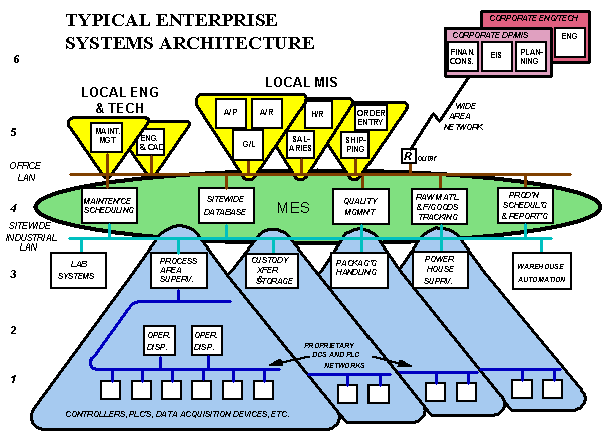
Like the PFD, the CIAD should be developed during the
Conceptual Engineering Phase at roughly the same time as the PFD or
MFD. Depending on the complexity and the state of definition of the
enterprise, the CIAD may be presented at various levels of detail
ranging from very "high level" (e.g. a half page representation of a
whole enterprise) to a much more detailed version showing each server
farm and block of users. Click
here for a more detailed description of CIADs and the rules for drawing
them.
Control and Information Network Diagram
(CIND) is a schematic representation of the information processing
nodes (computer systems) and communications (networks) which comprise
the Control and Information Systems of the Enterprise. CINDs are more
detailed drawings. In much the same way that the "Piping and
Instrumentation Diagrams" (P & IDs) used in process industries,
or manufacturing industries show major material flows and major
processing equipment and storage facilities, the CIND shows major
information flows, information processing, and storage systems. Click here for a more
detailed description of CINDs and the rules for drawing them.
The CIND is developed during the Preliminary Engineering Phase in
parallel with the P&IDs.
Sequence Control Flow Charts are developed to convey the
continuous (regularory loops), descrete control logic (interlocks), and
sequence control logic (sequence of operations, both manual and
automatic). These are developed during Preliminary Engineering Phase in
parallel with the P&IDs and CINDs.
There are a large number of diagram produced during the Detail
Engineering Phase to develop the next level of detail from the CIND.
These include:
- Network Diagrams
- Termination Diagrams
- Computer Configuration Drawings
- Continuous Control Logic Diagrams (e.g. SAMA)
- Discrete Logic Diagrams (e.g. Ladder Diagrams)
FROM OTHER PAGE:
The Control and
Information System Architecture defines the automated flow of informaton and control through the
enterprise. It also defines flow of information to the Human component
of the organization, and the return of commands to automated systems at
all levels. The Control and Information System also includes "low
level" automated control loops, and those higher level control
functions which have been automated.
The control and information system architecture is the newest
of the architectures, since automation of any kind was not possible
before the industrial revolution. The "Jaquard Loom" was probably the
first programmed discrete manufacturing production machine, and its
automation, although revolutionary was very locallized. The first
regulatory control loop was the centrifugal regulator invented to
control steam pressure on locomotives. Although control loops in early
refineries were many, most were given "set points" by an operator in a
local "unit control room", so graphical representation could be limited
to the PFD and P&ID. By this process, the P&ID evolved
to define both the "low level" automation functions, and the physical
production facility. In this the P&ID is unique, in that it
also shows the interface between the low level control functions and
the physical production facility.
P&IDs do not, however, represent the "higher level"
Control and Information Systems functions or networks. Initially, this
was not necessary, since the Human and Organizational component of the
Enterprise was responsible for all of these functions. Most recently
however, the advent of industrial LANs, Enterprise Integration, MRPII
(Manufacturing Resource Planning), etc., has resulted in very complex
"higher level" systems. These must be visualized in order to understand
and analyze them.
by Gary
Rathwell © reserved
Back
to PERA Home Page