What is an Enterprise Model ?
In the existing literature, Enterprise Models may
also be called Enterprise Architectures, or Enterprise Frameworks. Use
of these different terms has led to considerable confusion. On this web
site we have used "Enterprise Model" as the preferred terminology. The
term "Architecture" will be reserved for logical or physical
architectures which are the final result of the enterprise design
process.
Enterprise Models are comprised of:
- An overall conceptual framework (usually expressed
diagrammatically)
- Architectures, which may be physical (hardware) or
Logical (software) and
- Methodologies, which are different at each phase
of the enterprise, and for each organizational group.
| Enterprise Models also include a diagramatic
"framework" for structuring information about the enterprise. The PERA
"Wind chime" is an example of such a diagram. |
 |
 |
Enterprise Methodologies describe the work
processes involved in life cycle "phases" such as Master Planning,
Design, Construction and Operations. This PERA Master Planning flow
diagram is an example of a Methodology used during the Conceptual
Engineering Phase. |
| Enterprise Architectures indicate main
functional entities, and how these relate to other items in the
architecture. |
 |
 |
Logical architectures indicate how software
and information flows are structured. |
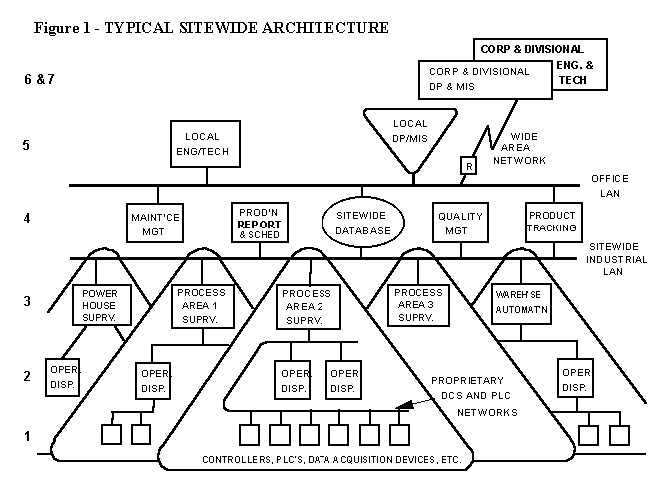
| Physical or Hardware Architectures indicate how computer
hardware and networks are structured according to the 4Rs (Response, Resolution, Reliability, and Resilience). |
 |
Both Physical and Logical architectures may be represented in greater or lesser detail, the least detailed being the overall Enterprise Architecture.
Click here for a list of Enterprise Methodologies and the Models they define.
by Gary
Rathwell © reserved
Back
to PERA Home Page