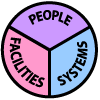
The PERA 4Rs are Response, Resolution, Reliability, and Resilience. These are all time-based measures, that are used to determine the criticality of devices and networks and therefore their assignment to a certain PERA Level. However, the nature of each of these measurements, and even the time parameters involved, may be quite different.
- Response is the time it takes to get the answer (e.g. seconds for an update from a field device). In a process plant, this would be the update rate on the DCS screen and might be a few times per second, but on a pipeline SCADA system Response time could be many seconds or even minutes. This parameter is particularly important for control loops as it determines how quickly the loop can respond to disturbances. Loop tuning and stability are discussed in more detail in Learning Maps for Control Engineers and Analyzer Specialists.
- Resolution is the result of the sample rate (or storage rate) of the device or network (from microseconds for a high-resolution breaker log, to seconds for a temperature scanner). In the old days, this was instantaneous, and the operator would often “tap the gauge” to see it “wiggle” to be sure that it was not stuck. With modern digital transmitters, the scan rate of the A/D converter determines the “standard deviation of the signal noise” which can actually be remotely read from some vendors’ sensors.
- Reliability is the classical MTBF (Mean Time Between Failure) which is often measured in months or years. Relibility may include the combined MTBF for equipment failure and failure of its protection system (e.g. for an SIS/SIL safety shutdown system). Note that statistical probabilities do not combine in a linear fashion (check your old statistics text books). It should also be noted that failure curves for electronics and software do not follow normal distribuiton cureves, but instead follow a "bathtub curve" with "infant mortality" followed by an extended low failure rate during extended operation.
- Resilience is defined as resistance to losses caused by unacceptable repair times, human error, and cyber-attacks. It is usually rated in terms of MTTR (Mean Time To Repair) or in the case of an operating error or cyber attack, the Mean Time to Recover. This includes the time to repair a failed device, or to swing over to a backup unit. In the case of a cyber attack this might involve reloading backup copies of programs or device configuration data.
Any of these 4Rs are the controlling requirement for a device, network, or system, and will therefore determine its Level in the Enterprise Architecture.
However, the 4R parameters also serve other purposes, for example:
- Response requirements will influence the choice of a transmitter or valve positioner required to achieve stable operation of a control loop.
- Resolution may determine the scan rate for a SCADA sensor measurement, or the band-width for a data link.
- Reliability many influence the choice (and cost) of a device. Mean Time Between Failures (MTBF) is provided for industrial devices and is used during operations phase to determine spare parts requirements.
- The "Resilience" requirement may determine whether to have an installed spare to improve the Mean Time to Repair (MTTR), or how long a control system should take to restore after a cyber attack.
See PERA Enterprise Architecture Levels for a more detailed discussion of how 4Rs are used in design of Control and Information Systems.
We welcome your Comments and Suggestions
Back to PERA Home Page