The PERA Master Planning Methodology was developed by the Purdue Laboratory for Automation and Industrial Control (PLAIC)) and published in 1991. Purdue agreed to make it freely available on the PERA website in 1998. Since then, although many related educational and instructional documents have been added, the 1991 version has received only minor editorial corrections.
The PERA Master Planning Methodology provides a structured way to plan:It is used at the beginning of the enterprise, program or project, typically during the Study and/or Conceptual Engineering phases. It may also be repeated and/or renewed at various points during the enterprise life cycle, including during Operations Phase or whenever major revamps or additions are undertaken.
|
|
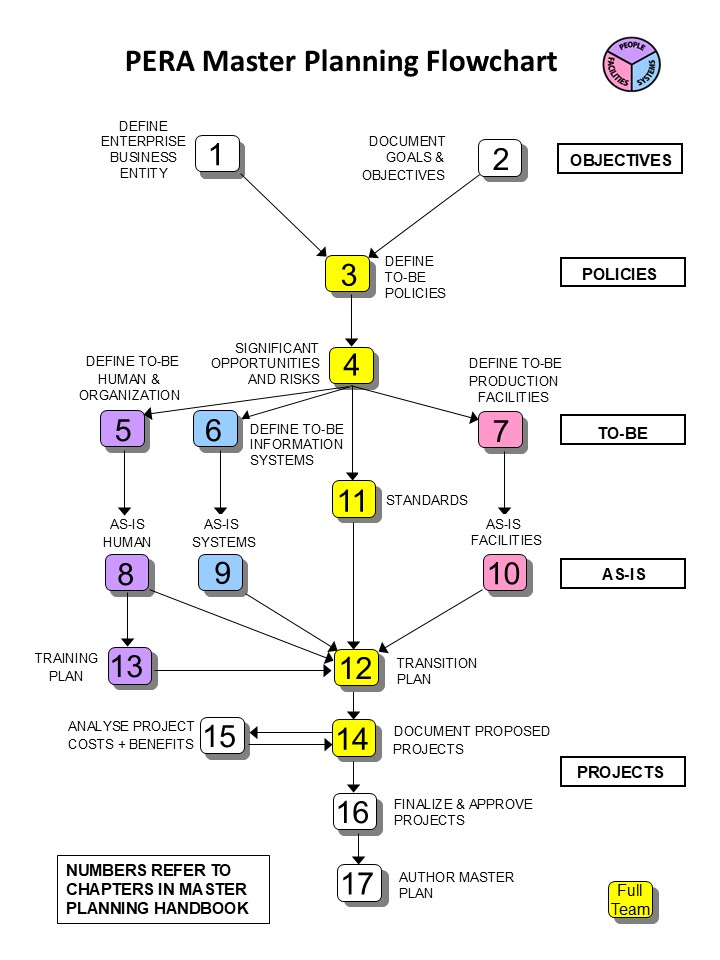
The following workflow diagram indicates the steps involved in the PERA Master Planning Process. PERA Master Planning is based upon principles defined in the PERA Model.
The PERA Master Planning Handbook provides a description of the methodology, as well as reference materials and examples.