| 
|
Control and Information Systems Architecture
|
|
|
The following discusses Control and Information System Architectures and associated technologies .
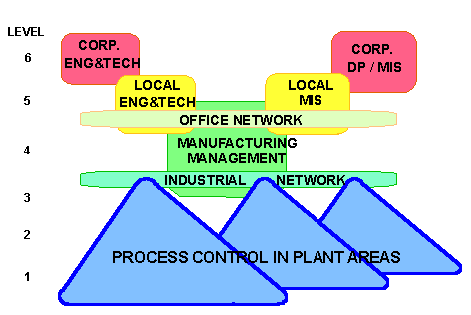
The Automation and Control System Architecture is designed progressively.
It begins with preparation of the System Architecture Diagram, which is completed during the Master Planning or Conceptual Engineering phase. This shows major control and information systems and network classes, but does not identify specific systems or networks.
It is at the same "Conceptual" level of detail as a Process Flow Diagram (PFD) or a Mechanical Flow Diagram (MFD) that are used to define the production equipment and how they are connected. It is also produced during the same phase (i.e., Master Planning or Conceptual Engineering).
During Preliminary Engineering (the next enterprise lifecycle phase), Logical Enterprise Architecture Diagrams and Physical Enterprise Architecture Diagrams expand the System Architecture information to the next level of detail as defined below.
Network Design Principals
During the Preliminary Engineering project phase, more detailed Logical and Physical Architecture Diagrams are produced.
- Logical Enterprise Architectures
- Physical Enterprise Architecture
- What are PERA 4Rs
- Response, Resolution, Reliability and Resilience
- Used to establish the "PERA Level" of systems, networks, and devices
- Segregation and Defence-in-depth strategies
- Follows Plant Area/Unit/Tag physical structure
- Follows Plant Area/Unit safety structure
- Follows Plant Area Risk structure
- Data structure
- Must follow Plant Physical Architecture in hazardous environments (e.g., in IACS ).
- May follow Logical Architecture in some environments (e.g., in office IT systems).
Industrial Networks
Includes Network type and Protocols
- Wired Industrial Networks including:
- Generic industrial networks and protocols such as Hart, Profibus, Fieldbus, and Modbus.
- Industry-specific networks and protocols such as CANbus and Etherloop.
- Digital radio networks including:
- Industrial, e.g., ISA100, Wireless Modbus, LoRaWAN, WiFi, and
- Office, e.g., WiFi and Bluetooth
- Public, e.g., wired, 5G, and 6G cellular
- Low Earth Orbit (LEO) and synchronous satellite networks.
- Industrial and Public Cellular 5G and 6G networks.
IoT and IIoT Data Acquisition and Networking
These networks and protocols provide flexibility and low cost; however, special care is required to ensure 4Rs (Response, Resolution, Reliability and Resilience) because they are based on Internet protocols (TCP/IP), use HTTPS servers, and potentially operate on public networks.
- Internet of Things (IoT)
- Industrial Internet of Things (IIoT)
IT Networks
Provide low cost and wide support. However, they must address different safety and security risks in:
- plant environments, and
- office environments
We welcome your comments and suggestions
Back to PERA Home Page